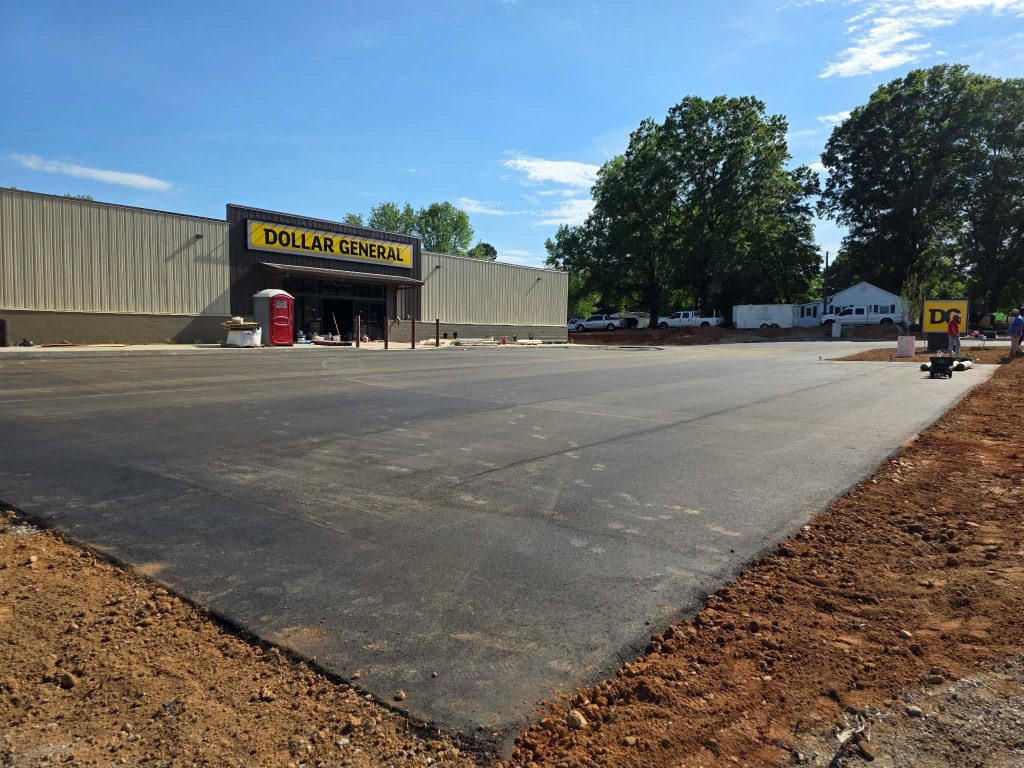
If you’ve never had a driveway paved before, the process can feel like a black box. You get a quote, a crew shows up, and a few days later there’s fresh asphalt in front of your house — but what actually happens in between? For homeowners in Mooresville, Davidson, Cornelius, and Huntersville researching asphalt driveway paving, understanding the process isn’t just satisfying curiosity. It’s the best way to spot a contractor who’s cutting corners before they ever touch your property.
This guide walks through exactly what a professional asphalt driveway paving job in Mooresville, NC should look like, from the first phone call to the final rolled surface.
Step 1: The On-Site Estimate for Your Mooresville Driveway
A legitimate asphalt paving contractor in Mooresville won’t quote your driveway over the phone or from a satellite photo. The first step is always an on-site visit, where the contractor measures the driveway, checks the existing surface (if any), inspects drainage patterns, and looks at soil conditions.
This matters because North Carolina’s red clay soil behaves very differently from sandy or rocky ground. Clay retains water and expands and contracts with temperature swings, which affects how the base layer needs to be built. A contractor who skips this step and just eyeballs your driveway from the street is already cutting a corner that will show up in a year or two as cracking or heaving.
During the estimate, ask about:
- Total square footage and thickness of asphalt to be installed
- Base preparation plan (see Step 2)
- Timeline and weather contingencies
- Written warranty terms
Step 2: Excavation and Base Preparation for NC Clay Soil
This is, without question, the most important step in the entire process — and the one most likely to be shortchanged by low-cost contractors. Asphalt itself is only as strong as what’s underneath it.
For a new driveway, the crew will excavate the existing soil or old surface, typically 6–8 inches deep depending on soil conditions and expected traffic (a driveway for two sedans needs less depth than one that will also handle a work truck or RV). Excavation removes topsoil, organic material, and any old crumbling asphalt or gravel that won’t compact properly.
Next comes the aggregate base — usually crushed stone (often ABC stone, or “aggregate base course,” is used across the Carolinas) compacted in layers, or “lifts,” using a vibratory roller. Each lift is typically compacted before the next is added, because compacting too much material at once leaves weak spots that won’t fully densify.
A properly built base does two things: it distributes vehicle weight across a wider area so the soil underneath doesn’t get overloaded, and it creates a stable, well-draining layer so water doesn’t pool and soften the ground under the asphalt.
Why this matters for your search intent: if you’re comparing quotes and one is significantly cheaper, ask directly how many inches of base will be installed and how it will be compacted. This single question separates most professional paving companies from corner-cutters.
Step 3: Grading and Drainage Planning in Mooresville, NC
Before any asphalt goes down, the base is graded to create proper slope — typically a minimum of 1–2% grade — so water sheets off the driveway instead of pooling. In Mooresville’s climate, standing water is a serious problem: it seeps into small cracks, and when temperatures swing below freezing in winter, that trapped water expands and accelerates cracking.
Good grading also protects your foundation, garage, or any structures near the driveway by directing runoff away from the home rather than toward it.
Step 4: Binder Course Installation for Durable Driveways
Larger or thicker driveways, and virtually all commercial jobs, use a two-layer asphalt system: a binder course followed by a surface course. The binder layer is coarser, with larger aggregate, and provides structural strength and load distribution. It’s typically installed 2–3 inches thick and compacted with a roller while still hot.
For smaller residential driveways, some contractors use a single-layer system, which can be perfectly adequate depending on traffic load and thickness — but it’s worth confirming which approach your quote includes, since a two-layer system generally lasts longer under heavier use.
Step 5: Surface Course and Final Compaction
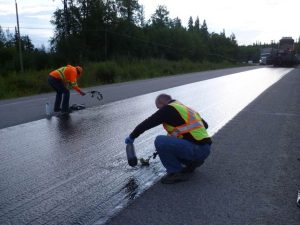
The surface (or “wearing”) course is the smooth, fine-aggregate asphalt layer you actually see and drive on. It’s laid at high temperature — asphalt needs to be compacted while it’s still hot, generally above 185°F, or it won’t achieve proper density. This is one reason paving schedules depend heavily on weather: pouring asphalt in cold or wet conditions can ruin the compaction and shorten the driveway’s life dramatically.
A paving crew will typically:
- Deliver hot asphalt mix by truck directly to the site or into a paver machine
- Spread it evenly to the specified thickness (commonly 2–3 inches for residential driveways)
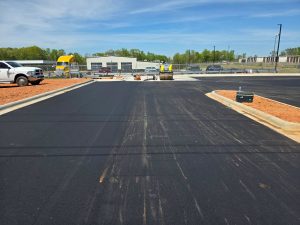
- Compact it in overlapping passes with a roller, working from the edges inward
- Hand-tool edges and transitions (like the connection to the garage slab or street) for a clean, sealed finish
Step 6: Curing Time for Your New Asphalt Driveway
Freshly paved asphalt is not instantly ready for use. It needs time to cool and harden:
- Foot traffic: generally safe within a few hours
- Vehicle traffic: most contractors recommend waiting 3–5 days
- Full cure (for parking heavy vehicles or in high heat): up to 30 days in some cases
A contractor who tells you it’s fine to park a car on it the same evening is either being careless or dishonest — this is one of the easiest ways to identify a rushed job.
Step 7: Sealcoating Your New Mooresville Driveway
Sealcoating isn’t part of the initial paving in most cases — asphalt typically needs 90 days to fully cure before sealcoat is applied. But it’s worth discussing during your original estimate, since it’s the single most effective way to extend the life of your new driveway. Sealcoating protects against UV damage, oil and gas stains, and water penetration.
What Separates a Good Mooresville Paving Job From a Bad One
When homeowners search for “driveway paving near me” or “best asphalt contractor Mooresville NC,” the differentiator usually isn’t the asphalt itself — most contractors buy from the same regional suppliers. The differentiator is process discipline: proper excavation depth, adequate base compaction, correct grading, and patience with cure times.
If you’re getting quotes for a new driveway, ask each contractor to walk you through these same steps. Their answers — or lack of them — will tell you more than any price comparison.
Ready to Get Started? Asphalt Driveway Paving Serving Mooresville, Davidson, Cornelius & Huntersville
J&J Paving & Asphalt Maintenance has served Mooresville, Davidson, Cornelius, Huntersville, Statesville, Concord, Kannapolis, and Troutman with professional, code-compliant asphalt driveway installation for over 25 years. If you’re ready for a free, honest on-site estimate — no vague guesses, no corner-cutting — reach out to our team today.